How to check dollars for authenticity: five checks in 30 seconds

CurrencyBy: ВладимирJuly 24, 20265 min read
How to check dollars for authenticity: five checks in 30 seconds

Updated: July 20, 2026.

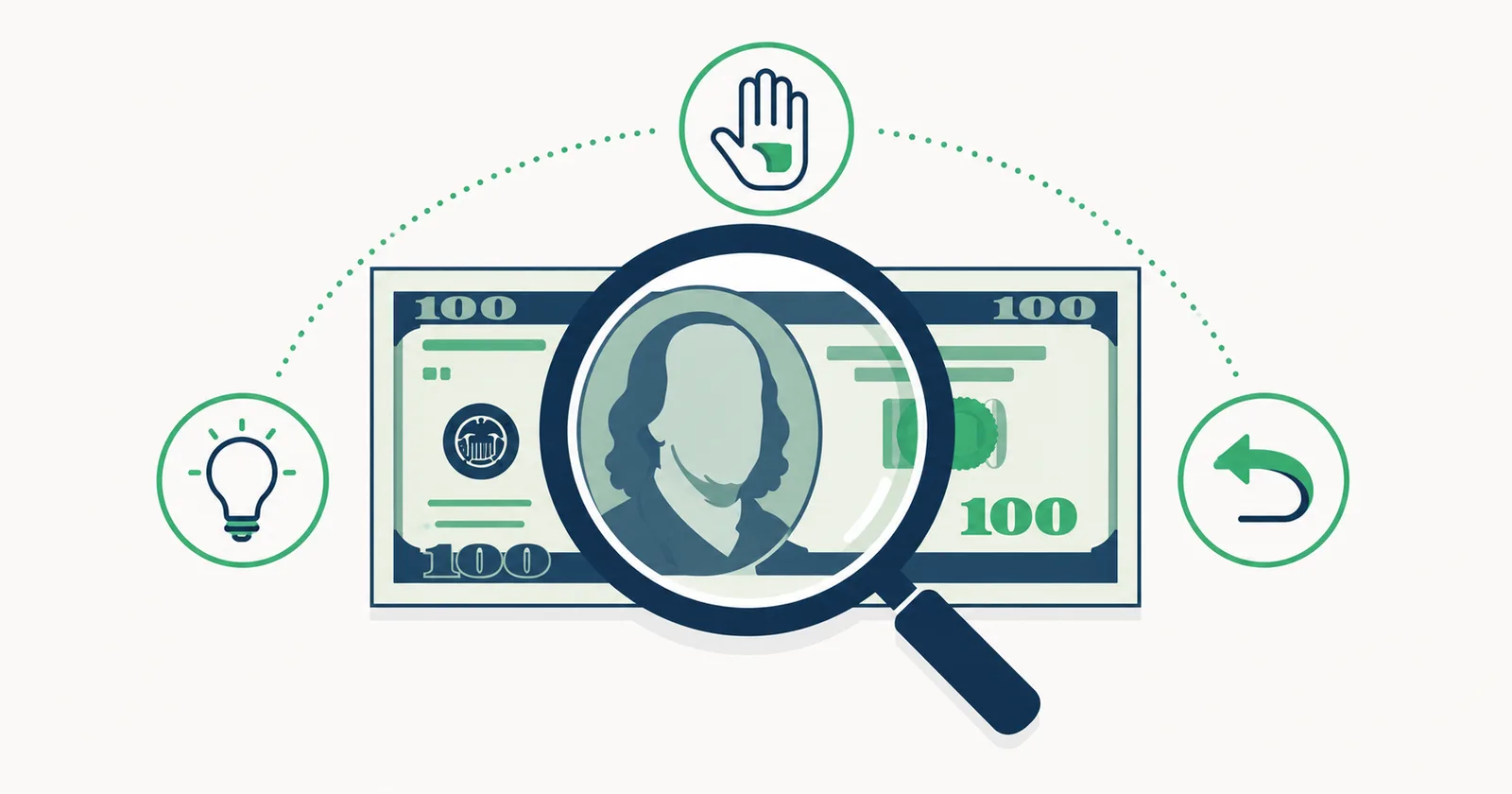
The authenticity of a 100-dollar bill can be checked without any equipment - according to the official instructions of the US Federal Reserve System, three actions are enough: touch, look at the light and tilt. Five security elements — relief printing, watermark, security thread, blue 3D tape and color-changing paint — are almost impossible to fake at the same time.

Five Checks on the One Hundred Dollar Bill (series since 2013)

  1. To the touch: paper and relief. Dollars are not printed on ordinary paper, but on canvas made of cotton and linen - it is dense, a little rough and "crispy". Run your fingernail along the collar of Franklin's jacket: the real print is embossed, the fake is usually smooth.
  2. To the light: protective thread. Hold the bill up to the light - to the left of the portrait runs a vertical embedded thread with repeating "USA 100". It is inside the paper, not drawn on top.
  3. On the light: watermark. To the right of the portrait, a second, inconspicuous image of Franklin appears in the light. It must be visible on both sides of the banknote.
  4. Leaning: blue 3D tape. The main element of new acres. Tilt the note - the bells on the blue ribbon move and become the number 100. Critical: the ribbon is woven into the paper, not printed or glued on top - test with your fingernail, it should not feel like a separate layer.
  5. On a slant: color-changing paint. The bell in the inkwell and the number 100 in the lower right corner change color from copper to green when tilted. In fakes, the color either does not change, or "transludes" unnaturally.

Cheat sheet: what and how to check

ActionElementWhat should be
to touchPaper + relief printingDense "crisp" paper, tangible relief on the Franklin collar
To the lightProtective threadVertical thread with "USA 100" to left of portrait
To the lightWatermarkSecond portrait of Franklin right, visible from both sides
TiltBlue 3D ribbonThe bells turn into "100", the ribbon is woven into the paper
TiltChameleon paintThe bell in the inkwell and the number 100 change color from copper to green

How to check old series of dollars

Banknotes before 2013 do not have a blue ribbon - this is normal and not a sign of counterfeiting. They test for the same basic elements: paper and embossing, a security thread (shines against the lumen), a watermark, and a color-changing ink on the face value. As a reminder: from June 18, 2026, banks and exchangers are obliged to accept real dollars of any year of issue at the usual rate - if you are refused because of the "old design", this is a violation.

Where fakes are most often introduced

The risk is minimal at bank counters and licensed money changers — there the bills undergo hardware verification at several levels (UV, infrared, and magnetic tags). Almost all real cases are exchanges "from hands": street changers, deals based on advertisements, selling currency "at a favorable rate" in the markets. The rule is simple: we buy cash currency only at licensed points that are easy to compare according to the exchange rate in the comparison service — a difference of 10 kopecks is not worth the risk of receiving a piece of paper worth zero.

What to do with a questionable bill

The main thing is not to try to spend it or exchange it: knowingly selling counterfeit currency is a criminal offense, and "I didn't know" after checking at the cash register sounds unconvincing. The right way: take the banknote to any bank for examination - the cashier will draw up an act and hand the bill over to the NBU for examination. If the banknote turns out to be genuine (this happens with worn bills), you will be refunded its value. If it is fake, it will be removed without compensation, but without any claims against you; if you wish, you can contact the police with a statement about where you got it. Compensation for fakes does not exist anywhere in the world - that is why bills should be checked at the time of receipt, and not after.

Frequently asked questions

Can you check dollars at home without equipment?

Yes: touch, clearance and tilt cover the five key elements of protection. The flashlight of an ordinary smartphone completely replaces the light from a lamp.

Do you need a UV lamp?

Optional, but useful: in ultraviolet, the protective thread of the web glows pink, and the paper itself does not "glow" bright blue, like ordinary office paper. This is a quick extra check for those who often handle cash.

What kind of marker is used by cashiers to check bills?

Iodine detector: it leaves a dark mark on ordinary paper with starch, and a yellowish mark on banknote paper. It screens out only the simplest counterfeits, so cashiers use it as a first check, not the only one.

Is a torn or rubbed bill a sign of counterfeiting?

No, status and authenticity are different things. A worn real bill must be accepted (a significantly damaged one - for collection at the bank), but the protective elements must be read regardless of the wear.

What will happen if the bank cash register detects a fake?

The bill will be withdrawn according to the act and sent for examination, no compensation is provided. Liability arises only for deliberate sale - therefore, if you find a fake, do not try to "fix" it, but submit it for examination.

The material is informative.

Your reaction:
#долар#готівка#безпека