Updated: July 20, 2026.
For daily operations in Ukraine, the most practical stablecoin is USDT: it has the most liquidity, is accepted by all exchangers, and transfers on the Tron network cost pennies. USDC, on the other hand, wins in regulatory reliability - monthly reports on reserves and an EU license - so for large amounts "for a long time" many choose it. Together, these two tokens control 83% of the roughly $315 billion stablecoin market. We analyze the differences in numbers and give a simple logic of choice.
What is a stablecoin?
A stablecoin is a cryptocurrency whose exchange rate is tied to a stable asset, most often to the US dollar in a ratio of 1:1. The issuer issues tokens and holds reserves (money and US government bonds) that guarantee the exchange of each token for a dollar. As a result, the stablecoin behaves like a "digital dollar": it does not jump in price like bitcoin, but it is transferred like a cryptocurrency - quickly, around the clock and without banks.
USDT (Tether): The largest and most liquid
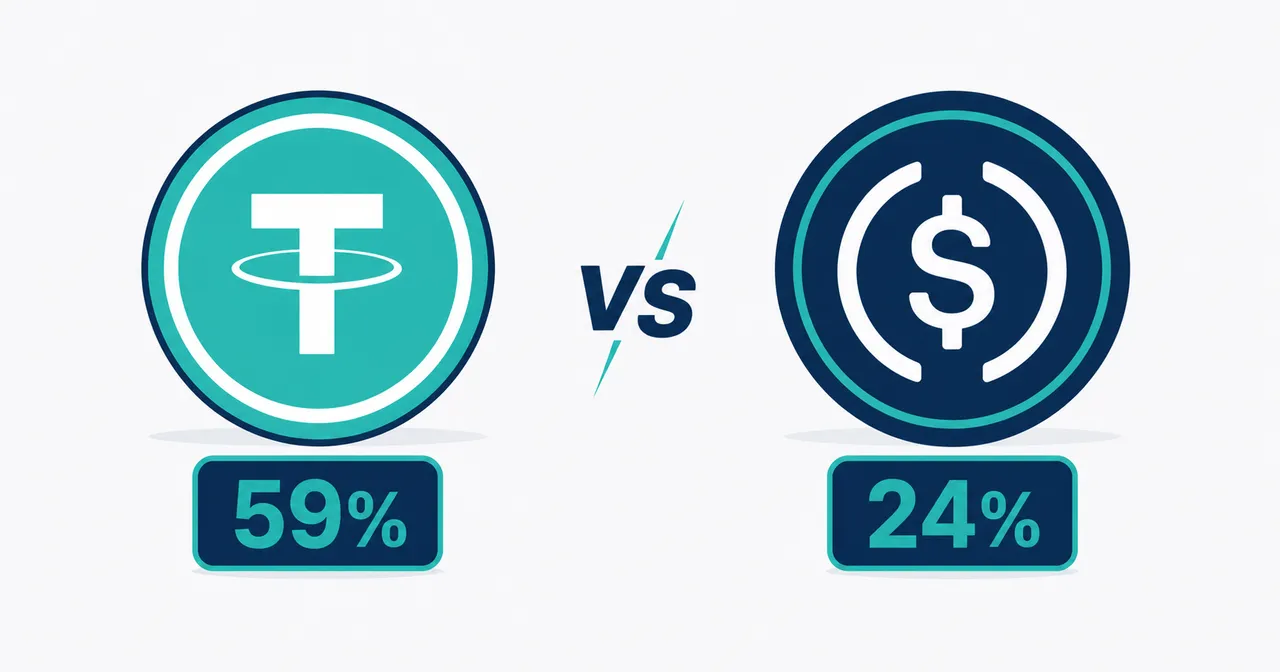
The capitalization of USDT is about $186 billion, which is 59% of the entire stablecoin market. The main strength is liquidity and prevalence: USDT is accepted by almost every exchange and exchanger in the world, including Ukrainian ones, and a transfer in the TRC20 network costs a fraction of a dollar. Tether's reserves consist primarily of US Treasuries and cash equivalents, but also include secured loans and bitcoin; reserve reports are published quarterly (BDO attestation). The company has never denied the redemption of tokens to verified customers, but Tether does not have a European MiCA license — so major EU exchanges have removed USDT from trading for retail users.
USDC (Circle): bet on regulation and transparency
Capitalization of USDC is about 75-77 billion dollars (24% of the market). This is the most "regulated" stablecoin: reserves are only in treasury bonds and money from large custodians (BlackRock, BNY Mellon), certifications are monthly (Deloitte), and after Circle goes public, the company reports to the SEC as public. USDC has a MiCA license in the EU since 2024 and is subject to the US GENIUS Act as a regulated payment stablecoin. The price of this reliability is lower prevalence in the cash-exchange infrastructure of Ukraine: the exchange rate and selection of pairs in local services are almost always better for USDT.
Comparison: USDT vs USDC
Other stablecoins: who needs them
The rest of the market is noticeably smaller: USDS (~$8 billion) and DAI (~$4.5 billion) — decentralized stablecoins of the Sky ecosystem, backed by cryptoassets; USDe from Ethena (~$4.5 billion) is a "synthetic dollar" that holds a peg through derivative positions and carries significantly higher risks than classic reserve tokens; PayPal's PYUSD (~$2.8 billion) is regulated, but still niche. For an ordinary Ukrainian user, these are more tools for DeFi strategies than a replacement for USDT/USDC. The main market lesson here is the collapse of the algorithmic UST in May 2022, which wiped out tens of billions of dollars in a week: a stablecoin with no real reserves is only stable as long as it is believed in.
Which one to choose: simple logic
For circulation in Ukraine - buying, selling, transfers to relatives, settlements - take USDT in the TRC20 network: the best exchange rates, minimal commissions, maximum compatibility. For storing large amounts for months and years, especially if you or your recipients are in the EU, USDC: more transparent reserves and a European license are worth the slightly worse conversion rate. A compromise approach used by advanced users is to keep the "cushion" in USDC and the working amount for transactions in USDT. Both are converted to hryvnias in the same way, and you can compare rates for both in the exchange catalog.
Risks common to all stablecoins
Stablecoin is an obligation of a private company, not a bank deposit: it is not covered by state guarantees. The key risks are the temporary loss of peg (depeg), as in USDC in March 2023, the issuer's problems with reserves or regulators, as well as the user's own mistakes: the transfer to the wrong network or to a phishing service is irreversible. The rules of hygiene are the same as for any crypto: proven services, two-factor authentication, own wallet for large amounts and no "rates better than the market".
Frequently asked questions
Could USDT lose its peg to the dollar?
Short-term deviations of a few cents occurred during periods of panic, but there was no complete loss of the peg for more than ten years, and the issuer performs the redemption of tokens. However, there are no state-level guarantees here - this is the risk of a private issuer.
What is backed by USDT and USDC?
Mostly US Treasuries and money. The USDC holds reserves from these assets only and is reconciled monthly; in USDT, secured loans and bitcoin are added to them, reports are quarterly.
Which stablecoin is the cheapest in transfers?
USDT on the TRC20 network is a fee from fractions of a dollar. USDC is cheap to transfer to Solana, Base or Polygon. The main thing is that the networks of the sender and recipient match.
Are stablecoins legal in Ukraine?
Buying, storing and selling are not prohibited; the market is waiting for the relevant law. Revenue from hryvnia sales is subject to declaration.
Which is safer: dollars in the account or stablecoins?
The foreign currency account at the bank is protected by state guarantees, the stablecoin — only by the issuer's reserves. But stablecoin is transferred anywhere in minutes. These are different tools: a bank is about protection, a stablecoin is about mobility.
The material is informative and does not constitute investment advice. Crypto assets are high-risk instruments.

 EN
EN