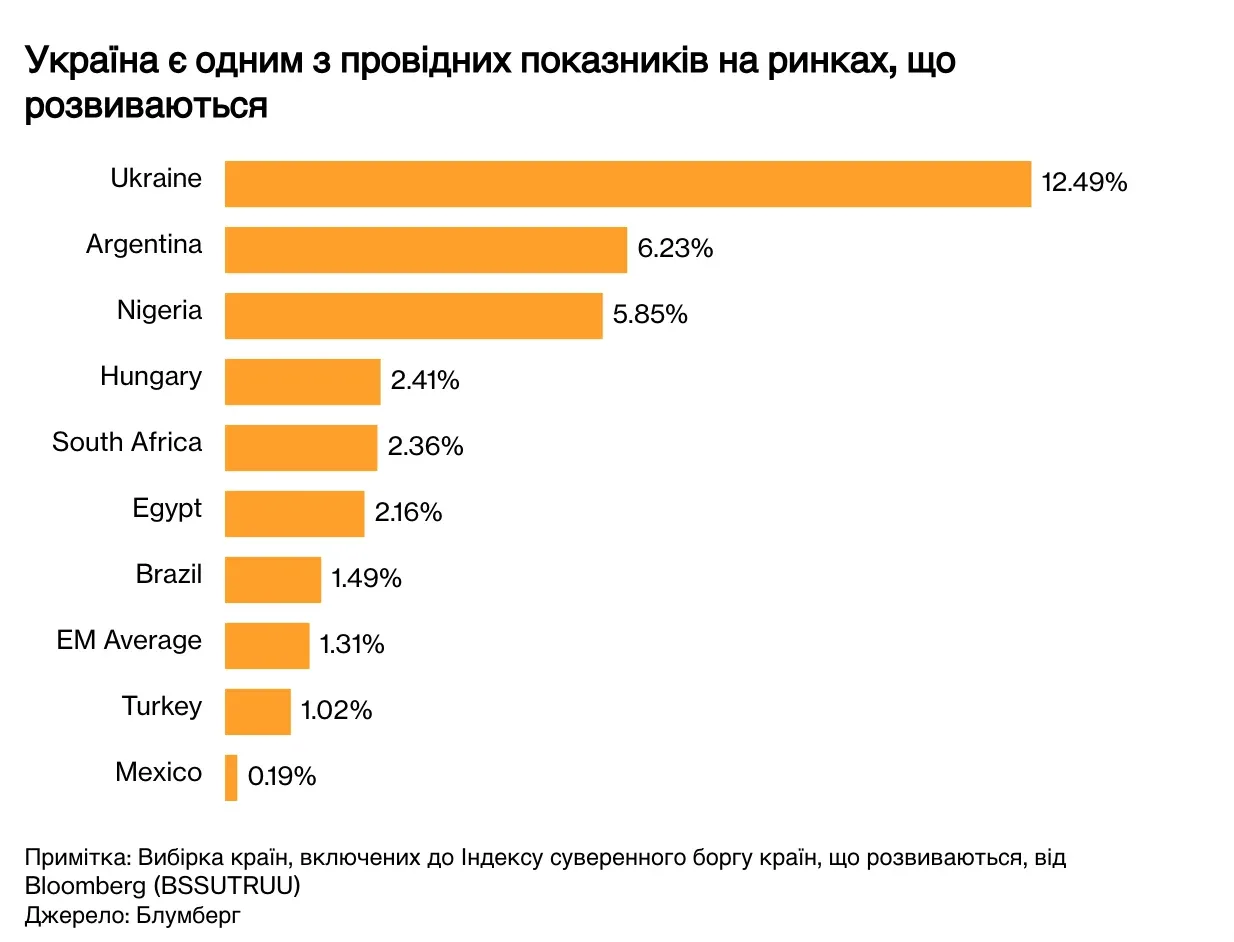
Ukrainian sovereign debt has become one of the most profitable assets on the debt market of developing countries. The index of nine dollar issues has increased by about 150% since the beginning of 2023, and by another 12% since the beginning of 2026.
Ukrainian Eurobonds continue to show strong dynamics despite the high risks associated with the war and the state of public finances. They support the growth of their value international financial assistance, debt restructuring and improvement of investors' expectations regarding the prospects of the Ukrainian economy.
Forbes Ukraine writes about this with reference to Bloomberg.
Ukrainian debt rose sharply in price
According to Bloomberg, the index, which tracks nine dollar issues of Ukrainian sovereign bonds, increased by about 150% since the beginning of 2023.
At the same time, the positive dynamics is maintained this year as well. In 2025, the index added approx 10%, and from the beginning of 2026 — more 12%.
Thus, Ukrainian securities have become one of the most profitable segments among the debt assets of developing countries.
The 2029 bonds are already worth 85 cents on the dollar
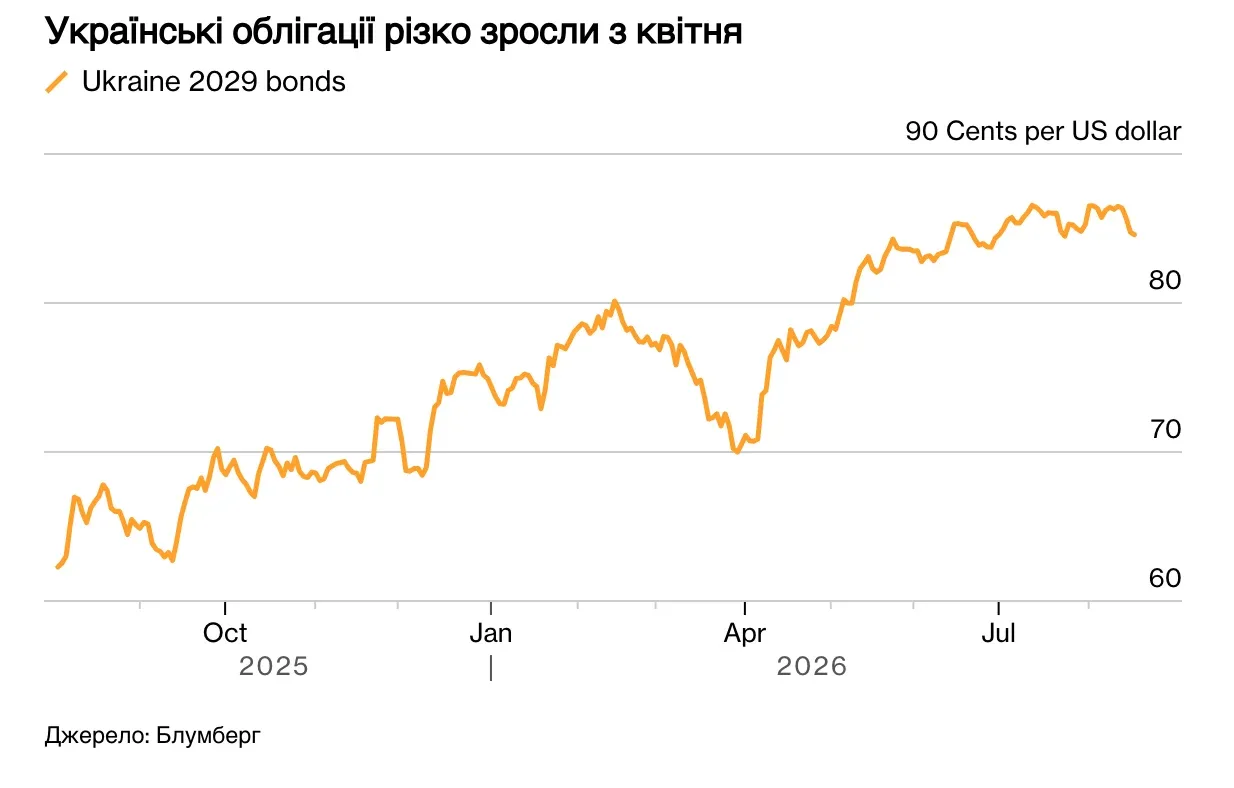
The dynamics of Ukrainian bonds maturing in 2029 is illustrative.
They are currently trading at approx 85 cents per $1 face value, and their profitability is close to 13% per annum.
Back in June 2025, these papers were worth only approx 58 cents on the dollar.
That is, in a little more than a year, their market price has increased significantly. For investors, this means an opportunity to receive not only a high coupon income, but also a significant capital gain in case of further price appreciation of securities.
Why investors buy Ukrainian debt
One of the main factors supporting Ukrainian bonds has become stability of international financial support.
Ukraine continues to receive significant amounts of funding from partners, primarily the European Union. At the beginning of 2026, European politicians agreed on a credit package for Ukraine €90 billion, or about $106 billion.
For investors, this is an important signal: foreign aid reduces the risk that Ukraine will not be able to fulfill its debt obligations due to a deficit in budget funding.
The second factor was restructuring of public debt. Ukraine's arrangements with creditors have changed perceptions of its debt position and helped reduce fears of a potential default.
The gap with US bonds is narrowing
Another indicator of improving investor sentiment is the narrowing of the spread between Ukrainian and American government bonds.
The difference between the yield on Ukrainian debt and US Treasury bonds has shrunk to 7.4 percentage points.
In January, this indicator was about 2.5 p.p. bigger.
This means that investors are now demanding a smaller additional premium for the risk of Ukraine compared to the beginning of the year. At the same time, the gap remains very significant, which indicates the persistence of a high level of risk.
Ukrainian corporate bonds are also growing
The positive trend extended not only to the public debt.
Ukrainian corporate bonds also brought significant returns to investors in 2026.
In particular, papers Metinvest NV provided close to 31% of income since the beginning of the year, while bonds Naftogaz added close 23%.
For comparison, such dynamics significantly exceed the yield of most traditional low-risk debt instruments.
High return is compensation for high risk
Despite the rapid rise in prices, Ukrainian bonds have not become a safe asset.
Their high profitability is largely risk premium, which remains extremely high because of the war.
Negotiations on the end of the war have not yet produced a final result. Russia continues to attack Ukrainian infrastructure, particularly energy facilities and Black Sea ports.
New large-scale attacks could negatively affect production, exports, government revenues and the ability of the economy to recover quickly.
Debt burden remains a problem
A separate risk is the scale of public debt.
According to the estimates of the Kyiv School of Economics, the public debt of Ukraine already exceeds the size of the annual GDP.
By 2027, the public debt-to-GDP ratio may grow to approx 110%.
This means that even with a positive development of the situation, Ukraine will have to work for a long time on managing the debt burden, restructuring liabilities and attracting external financing.
What will happen to Ukrainian bonds next?
The further dynamics of Ukrainian debt will largely depend on three factors: the course of the war, international financial support and prospects for economic recovery.
If military risks decrease and international aid remains stable, Ukrainian bonds may gain additional potential for growth. In such a case, investors may demand a lower risk premium, which will support security prices.
At the same time, an aggravation of the war, problems with financing or a worsening of the macroeconomic situation can quickly reverse this trend.

 EN
EN