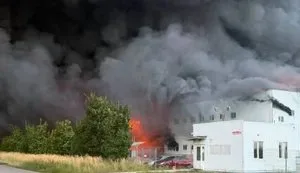
The Russian attack hit retail and business warehouses: which companies were affected
BusinessBy: Редакція ФінансистAugust 20, 20264 min read
Share:
Which companies suffered losses
Among the victims — Fine Ices, Fora, VARUS, ECO Market, Yves Rocher Ukraine and KLO.
The main distribution warehouse suffered the greatest losses "Fine ices" in Kyiv. The company actually lost the object: the warehouse, finished products, equipment and transport were destroyed. We are talking about significant volumes of craft ice cream, which was stored at the enterprise.
Warehouse infrastructure "Handicap" also came under attack. This facility was of particular importance because the company had only started using it about a week before the new attack. The previous composition of the network was already affected by the strike on August 5.
A warehouse was damaged in Boryspil VARUS, where part of the network's inventory was stored. Damage to a logistics facility can affect the speed of replenishment of stores and the availability of certain categories of products.
Problems also arose in "ECO market". Due to strikes on the transport infrastructure of the Boryspil district, the network faced disruptions in logistics. Even without direct destruction of the warehouse, attacks on transport nodes can significantly complicate the delivery of goods.
The warehouse was significantly damaged Yves Rocher Ukraine. Due to the consequences of the attack, the company was forced to temporarily suspend online orders. This shows how quickly physical damage to one logistics facility can turn into problems for customers.
Separately suffered KLO oil depot in Brovary district. As a result of the hit, the fuel tanks were destroyed.
Why warehouses became one of the main goals
A warehouse is not just a place where goods are stored. For large retail chains it is the central link of the entire supply system.
Goods for dozens or hundreds of stores can pass through one distribution center. Therefore, the destruction of such an object creates a domino effect: the company simultaneously loses stocks, equipment, transport, and stores may be left without regular replenishment.
Categories with a short shelf life are especially vulnerable — fresh products, frozen goods and products that require special storage conditions.
The scale of the problem is already beyond the boundaries of individual companies
In the first half of 2026, Ukraine was destroyed or damaged more than 300 thousand sq. m. m of warehouse space. Due to the increased impact on the logistics infrastructure, the losses of the warehouse sector are approaching the scale of 2022.
For comparison, in 2022 only in the Kyiv region was destroyed approx 400 thousand square meters m of professional warehouse space.
Thus, the problem gradually turns from local losses of individual companies to systemic risk for Ukrainian trade and logistics.
What this means for consumers
In the short term, the consequences may appear in the form of temporary shortage of certain goods, interruptions in delivery and changes in assortment in stores.
The greatest risk is for fresh produce and frozen produce, as they are more difficult to quickly reroute through alternative logistics centers.
At the same time, large chains already have the experience of working after the destruction of warehouse infrastructure and are trying to transfer operations to other facilities. However, each new attack means additional costs for rental of alternative warehouses, transportation, restocking and reconstruction of logistics routes.
Business loses not only property
A blow to the warehouse infrastructure has much wider economic consequences. Companies lose goods and equipment, the state loses part of tax revenues, and the labor market loses jobs.
In addition, the costs of insurance, logistics and reservation of warehouse capacities are increasing. This means for business increase in the cost of operations, and in the future, part of these costs may be reflected in the final prices for consumers.
Against this background, the state is already looking for alternative premises for the affected business: the State Property Fund has prepared 163 thousand square meters. m of area, which can be used as warehouses for companies that lost their facilities due to shelling.
The main conclusion: Russian attacks on warehouses are not only an attack on specific companies. This is an attack on the logistics chain, which depends on the supply of stores, the work of manufacturers and the stability of the domestic market.

 EN
EN