The primary housing market is gradually recovering
The Ukrainian market of new buildings continues to adapt to work in wartime conditions. Despite the difficult economic situation, developers are returning to the implementation of residential projects, and buyers are gradually renewing their interest in purchasing apartments.
According to the research DIM.RIA, from the beginning of the full-scale invasion, starting in March 2022, already put into operation in Ukraine 683 residential complexes, which cover 1339 sections.
This indicates a gradual revival of the primary market, although the pace of recovery varies significantly depending on the region and the security situation.
Where are the most new buildings being built now
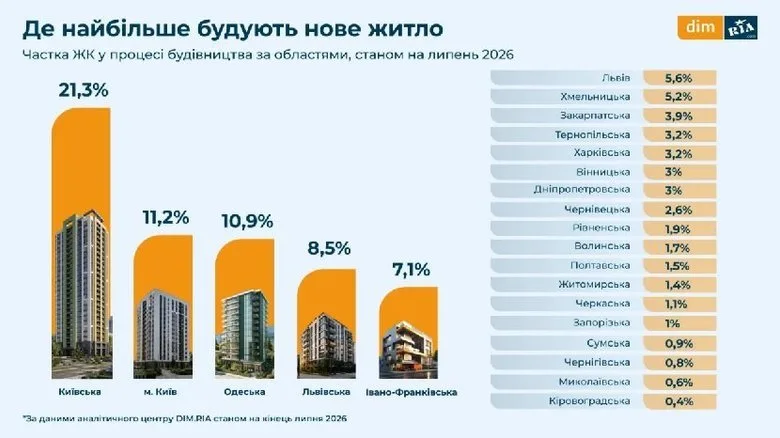
As of July 2026, construction is ongoing in Ukraine 2775 residential projects.
The largest concentration of new buildings is traditionally observed in the central and western regions of the country.
He remains the leader Kyiv region, where, excluding the capital, is located 21.3% of all residential complexes of the country.
It is in second place Kyiv with a particle 11.2%, and occupies the third position Odesa region — 10.9%.
The regions with the most active construction also include:
It is these regions that currently form the main part of new housing construction in Ukraine.
What kind of housing are offered by developers today
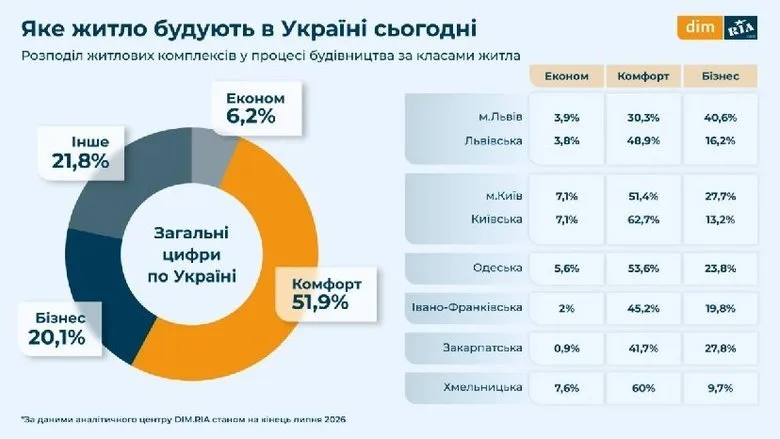
The largest share of new housing is apartments comfort class.
Their share reaches 51.9% of all objects under construction in Ukraine.
Takes second place business class — 20.1%, whereas economy housing is already only 6.2% market.
Yet 21.8% accounts for premium residential complexes, cottage towns and townhouses.
Experts note that such a structure demonstrates a change in customer preferences. Demand is gradually shifting towards higher quality housing with modern infrastructure, energy efficiency and additional services.
Lviv stands out among other cities
Lviv remains one of the peculiarities of the Ukrainian market.
If in most regions the comfort class dominates, then in Lviv the largest share is occupied by apartments business class.
They constitute 40.6% of all new buildings in the city.
For comparison, comfort-class housing in Lviv takes only 30.3% market.
Experts attribute this to the high demand for modern housing among internal migrants, investors and buyers with a higher income level.
Government programs remain one of the drivers of demand
State programs to support the purchase of housing continue to play a significant role in the primary market.
Most of the new buildings that can be purchased under programs "eOselya" and "is Recovery", now offered at:
- Poltava region — 79%;
- Vinnytsia region — 51%;
- Dnipropetrovsk region — 47%;
- Transcarpathian region — 47%;
- Kyiv region — 46%;
- Lviv region — 45%.
These regions today offer buyers the largest selection of housing that meets the conditions of state programs.
In the frontline areas, the situation remains difficult
A radically different situation is observed in the regions near the front line.
In the Chernihiv, Sumy, Kharkiv, Zaporizhzhya, Kherson, and Mykolaiv regions, there are currently almost no new buildings that participate in the "eHome" or "eRecovery" programs.
The reason remains the high level of security risks, due to which developers are in no hurry to launch new projects.
Where Ukrainians are most actively looking for apartments
Buyer demand is also concentrated in a few large regions.
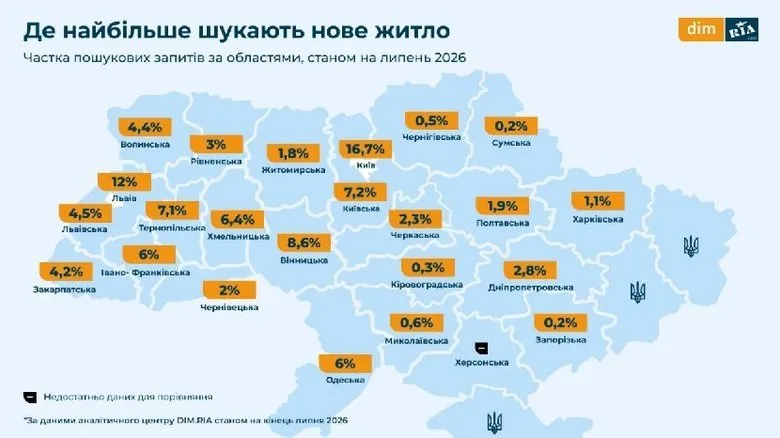
The largest number of inquiries regarding the purchase of housing falls on Kyiv, which forms 16.7% all searches for new buildings.
Takes the second position Lviv with an indicator 12%.
Also, high interest of buyers is observed in:
- Vinnytsia region;
- Kyiv region;
- Ternopil region;
- Khmelnytskyi region.
Instead, the lowest demand was recorded in Sumy, Zaporizhzhia, Kirovohrad, Chernihiv and Mykolaiv regions.
The "eOselya" and "eRecovery" programs stimulate demand
If we analyze separately housing that is available under state programs, then most Ukrainians are interested in such apartments in the capital.
Kyiv accounts for more than 22% of all searches for new buildings available with state support.
The regions of greatest interest also include:
- Vinnytsia region;
- Kyiv region;
- Odesa region;
- Khmelnytskyi region.
This confirms that government programs remain one of the main factors supporting the primary market.
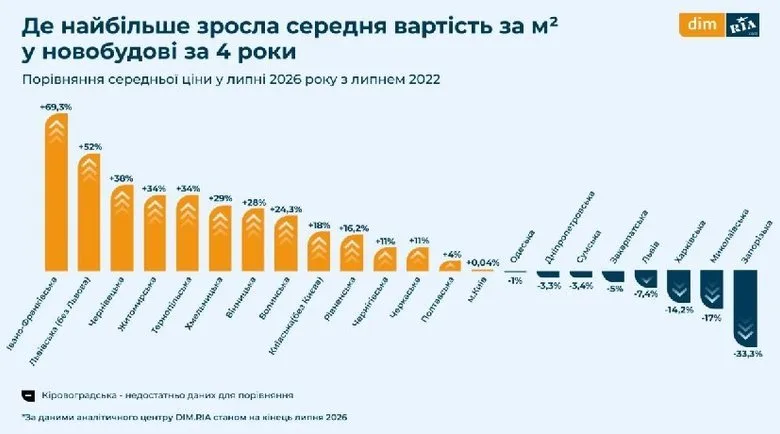
Where the square meter has become more expensive
Over the past year, prices on the primary market have continued to rise almost throughout Ukraine.
The biggest price increase was recorded in Ivano-Frankivsk region, where the average price per square meter increased immediately by 20% and reached 1089 dollars.
She took second place Vinnytsia region, where housing became more expensive at 17%, and the average price per square meter reached 1072 dollars.
The same rate of growth was also shown Lviv region, where a square meter costs close to 1055 dollars.
A significant increase in prices was also recorded in:
Why new buildings are becoming more expensive
Experts explain the increase in prices by several factors at once.
Among the main reasons are an increase in the cost of construction materials, a shortage of labor, an increase in logistics and energy costs, as well as a gradual recovery in housing demand.
Additional influence is provided by government lending programs that stimulate purchasing activity and support sales even in difficult economic conditions.
What is happening to the housing market
Despite all the challenges, the Ukrainian primary real estate market is showing gradual recovery.
Construction companies are more actively completing previously started projects and launching new residential complexes in relatively safe regions. At the same time, buyers are increasingly choosing housing that meets the conditions of state financing programs, which allows them to purchase an apartment on more favorable terms.
Experts predict that the further development of the market will largely depend on the security situation, the availability of mortgage programs and the pace of the country's economic recovery. If these factors remain positive, the demand for new buildings may continue to grow in the second half of the year.

 EN
EN