
 EN
EN
Updated: July 20, 2026.
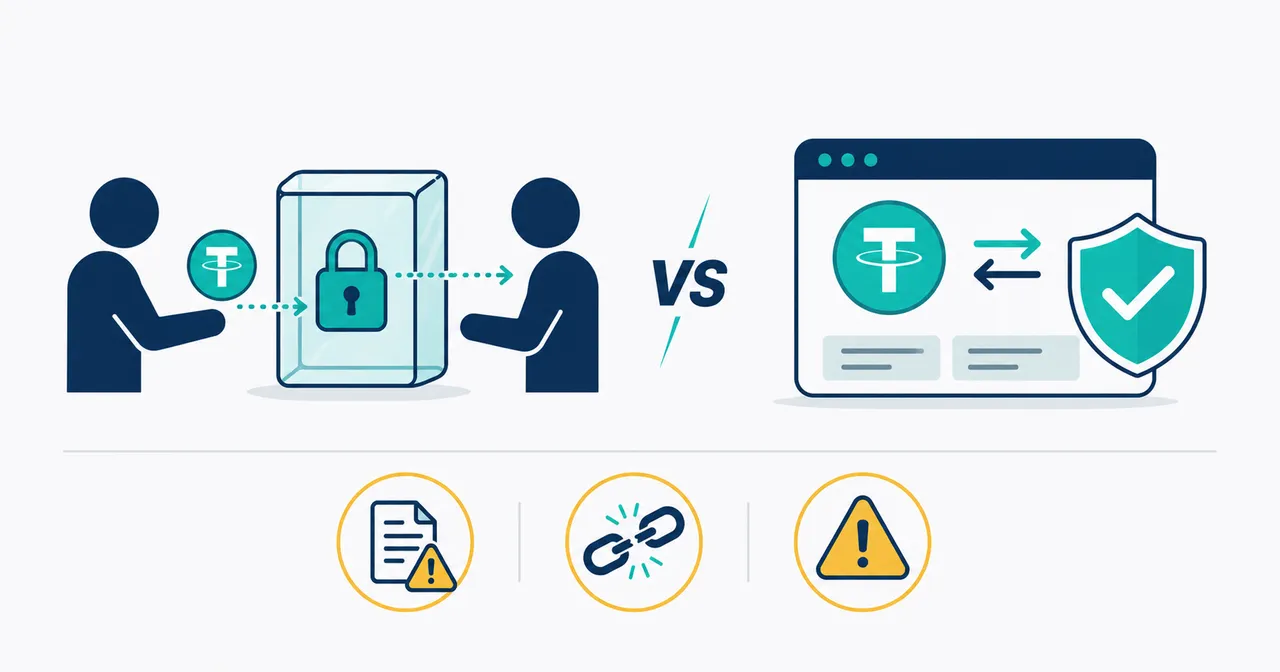
Both methods are safe if you understand their weaknesses — and they are different. P2P on a large exchange protects escrow, but leaves the human factor: you are trading with a stranger, and it is people who are building all the fraudulent schemes. The online exchange removes the human factor — the counterparty is the service — but transfers all the risk to the choice of the service itself. The cost of error is rising: according to Chainalysis, victims of crypto fraud will lose $17 billion globally in 2025, and phishing schemes will grow by 1,400%. We analyze the mechanics of both methods, the eight most common fraud schemes and checklists, after which the chances of losing money go to zero.
How P2P works and what actually protects escrow
P2P (peer-to-peer) is an agreement directly with another user on the exchange platform (Binance, Bybit, OKX, WhiteBIT). The main protection mechanism is escrow: when the order is created, the seller's cryptocurrency is automatically blocked by the exchange and cannot be withdrawn until the buyer confirms payment and the seller confirms receipt of money. That is, the scenario "I sent the hryvnia - but the crypto was not given" completely closes the escrow.
What escrow doesn't close, and this is key: the exchange doesn't see your bank account. She does not know whether the hryvnia actually arrived, or whether the screenshot of the receipt is real, or whether the sender's name matches the order. The entire fiat part of the deal depends on the attentiveness of the participants themselves — this is where fraudsters work. The second specific risk of P2P is not criminal, but banking: transfers from dozens of unknown individuals are the main trigger for financial monitoring and card blocking.
How the online exchange works
An online exchange is a service that acts as the other party to the transaction: you create an application, the service provides details, and after payment sends crypto (or vice versa). There is no human factor — there are no schemes with fake receipts and bogus buyers. The exchange rate is slightly worse than P2P: the service places its spread at 0.5–2%. All the risk is concentrated in one question: whether the exchanger itself is genuine and in good faith. The answer to it is provided by reputational mechanisms — the age of the service, ratings in aggregators, live reviews.
Comparison: P2P vs Exchange
| Criterion | P2P on the exchange | Online exchanger |
|---|---|---|
| Course | Best (seller competition) | Minus spread 0.5–2% |
| Protection of the agreement | Exchange escrow + appeal | Service reputation |
| The main risk | Fraudulent counterparty, the fiat part of the deal | Dishonest or fake service |
| Risk of card blocking | The highest (transfers from individuals) | Low (payment from the service) |
| Entrance threshold | Exchange registration + KYC | Often without an account for small amounts |
| Speed | 10–20 minutes | 10–30 minutes |
| Who suits? | Experienced, on the best course | For beginners and those who value simplicity |
Five main P2P fraud schemes
1. Fake confirmation of payment.The buyer sends an edited or AI-generated screenshot of the receipt and clicks: "money on the way, crypto release, bank delays." The protection is one and there is no alternative: release only after actual enrollment in your banking application. A screenshot is never proof.
2. Triangular scheme.Two people work: one creates an order with you, and a third person sends you money - often a victim of another scam or drop. Later, the payment is disputed and the claims come to you. One sign: the name of the sender does not match the order data. In case of any disagreement, do not publish and contact support.
3. Chargeback.The buyer pays, receives the crypto, and then disputes the transfer with their bank as "erroneous". Protection: work only with payment methods without easy withdrawal, withstand a pause of 15-20 minutes after enrollment and save all correspondence in the chat of the order - it will be evidence in the appeal.
4. Changing details in the chat."This card doesn't work, switch to another" is a classic. You can pay only using the details from the order itself; any request to change something in the process is a reason to cancel the agreement. Likewise, you cannot follow links from the chat: the exchanges do not send them there.
5. Fake support service.The "Binance moderator" writes in private or directly in the chat agreement: the account is allegedly blocked, you need to release funds or report the 2FA code. Real support never writes first in P2P chat and never asks for seed phrase, codes or release. In December 2025, the FBI alone warned more than 8,000 potential victims of such schemes.