July became one of the most difficult months for the oil infrastructure of the Russian Federation
According to the data Bloomberg, during July major Russian refineries, oil tankers, pipelines and marine facilities were at least 30 attacks. This is the second highest rate in all time of a full-scale war.
Not yet included in these statistics eight tanker incidents, which worked through the terminal of the Caspian Pipeline Consortium. If these attacks are officially attributed to Ukrainian operations, July will become a record month for the number of strikes on oil assets linked to Russia.
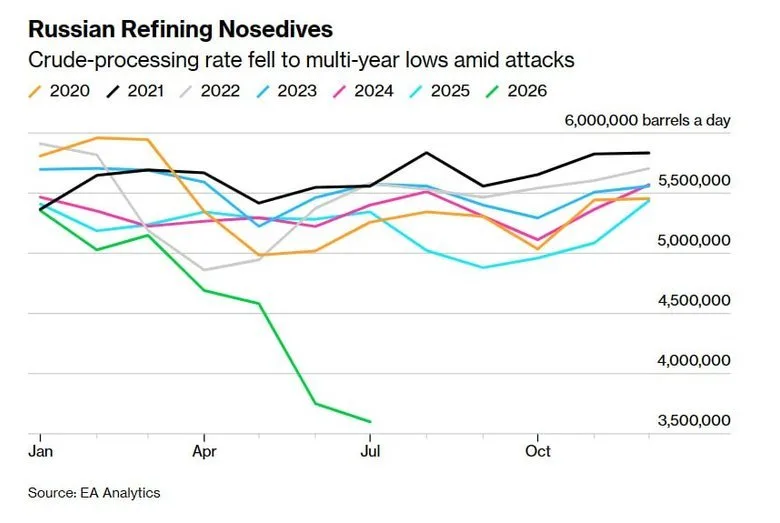
Recycling has fallen to its lowest level since 2002
According to estimates EA Analytics, in July, Russian refineries processed only 3.6 million barrels of oil per day.
For comparison:
Such a reduction indicates significant problems with the work of the oil refining industry, which remains one of the key sources of income for the Russian budget.
Which plants suffered the biggest losses
In recent months, attacks have affected almost all of the largest Russian oil refineries.
Among them:
- Omsk Refinery — Russia's largest oil refinery, which was forced to suspend operations after a drone attack;
- "Gazprom Naftohim Salavat" — one of the country's largest petrochemical complexes, which temporarily stopped production;
- "Permnefteorgsintez" — stopped about a third of its production capacity after the drone attack;
- NORSY ("Nizhegorodnefteorgsintez") — one of the largest producers of gasoline in the Russian Federation, which was also forced to stop work;
- Moscow Refinery, which supplies fuel to the capital region, was severely damaged and, according to preliminary estimates, will remain unavailable for at least six months.
In addition, significant damage was sustained Kuibyshevsky, Syzransky, Novokuibyshevsky, Volgograd refineries, as well as complexes "TANECO" and "TAIF-NK" in Tatarstan.
Recovery is slow
Despite attempts to resume production, only a small part of enterprises managed to return to full-fledged work.
According to the latest data, from 26 Russian oil refineries, which temporarily stopped production after the attacks, only 8 were able to fully resume work. The rest continue to work with reduced productivity or are in the process of repair.

 EN
EN