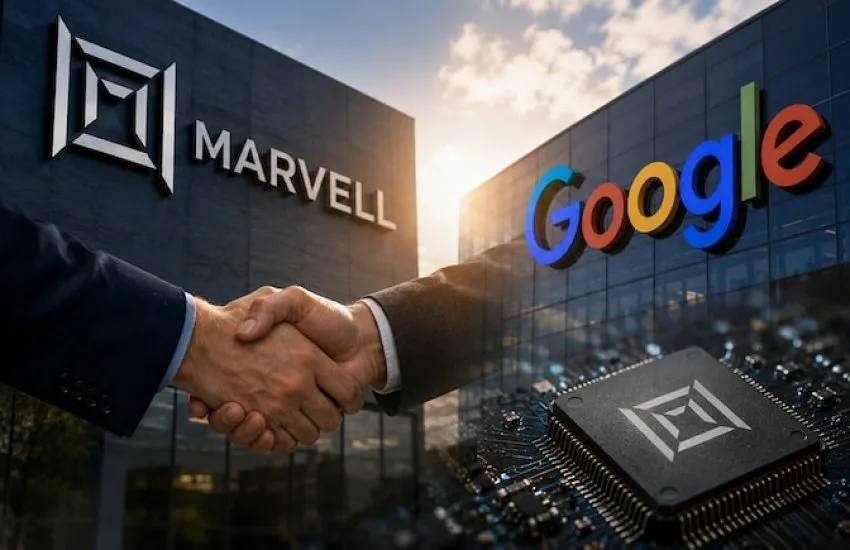
Google may invest $12.2 billion in Marvell: a bet on its own AI chips
BusinessBy: Редакція ФінансистAugust 19, 20264 min read
Share:
Google received the right to a billion block of shares
Under the terms of the agreement, Google may purchase to 58.97 million Marvell shares for the amount of about $12.2 billion.
It is important that it is about the right to purchase shares, and not about the immediate purchase of such a package. If Google implements it fully, the company can become the fifth largest shareholder of Marvell.
For Marvell, this arrangement means much more than just potentially attracting a major investor. It is connected with long-term cooperation in the field of development of specialized processors for AI.
Marvell will help Google build TPU
Marvell will work on technologies for Tensor Processing Units (TPU) — Google's own processors designed to perform artificial intelligence tasks.
TPU is one of the key elements of Google's hardware strategy. The company uses them to work with large machine learning models and other AI workloads.
Collaboration with Marvell will cover more than just computing components. Companies will also work on data storage and information transfer technologies between networks.
This is important because modern AI systems require not only powerful processors, but also extremely fast exchange of large volumes of data between data center components.
Marvell can get $120 billion in revenue
The potential financial impact of the deal for Marvell far exceeds the value of the stake.
If Google fulfills the terms of the agreement, the cooperation could bring Marvell about $120 billion in revenue by fiscal year 2033.
For the semiconductor manufacturer, this opens up access to one of the largest and fastest growing segments of the market — infrastructure for artificial intelligence.
For Google, in turn, the long-term partnership helps ensure the necessary production capacity in conditions of a rapid increase in demand for AI computing.
Investors reacted to the deal
The news immediately affected the company's quotations.
Actions Marvell rose almost 8%, as investors positively assessed the prospect of large-scale long-term business with Google.
Shares instead Broadcom down more than 5%.
Before that, Broadcom was one of Google's main partners in the development of specialized chips. Therefore, the market perceived Marvell's involvement as a potential increase in competition for Google's orders.
Actions Alphabet, the parent company of Google, have not changed significantly.
Google isn't giving up on Broadcom
Despite the drop in Broadcom shares, the deal with Marvell does not mean that Google will completely stop working with its previous partner.
Analysts consider the new agreement primarily as expanding the pool of suppliers.
Google needs more and more computing power to develop its own AI services, so the company is interested in increasing production capabilities and reducing dependence on individual suppliers.
This approach also allows Google to gain more control over the supply chain of key components.
Why tech companies are building their own AI chips
The production of own processors has become an important part of the strategy of the largest technology companies.
The main reason is cost and availability of computing power.
Generative AI requires a huge number of processors, and demand for hardware from Nvidia and other manufacturers remains high.
By creating their own specialized chips, companies try to:
- reduce dependence on third-party suppliers;
- -optimize equipment for own AI models;
- control the costs of calculations;
- increase the energy efficiency of data centers;
- to guarantee the necessary volumes of supplies.
For Google, such own solutions have become TPUs.
Google expands TPU production
The partnership with Marvell is not Google's only direction in the development of its own AI processors.
Earlier it was reported that the company ordered production more than 3 million tensor processors at Intel. The corresponding production is planned for 2028 year.
Thus, Google is simultaneously working with several manufacturers and forming a wider production base for the next generation of AI infrastructure.
Google is not only competing for chips
The deal with Marvell shows that competition in the field of artificial intelligence is gradually moving from the AI models themselves to the entire infrastructure.
Technology companies need chips, servers, memory, storage systems, network equipment and data centers.
That is why large AI developers are increasingly entering into long-term contracts with hardware manufacturers and even getting stakes in them.
Other companies are already using a similar model. For example, AMD has given OpenAI the option to buy up to about 10% of its shares within the scope of the agreement on the supply of AI chips.
This demonstrates a new trend: the largest developers of artificial intelligence are looking not just to buy hardware, but to financially and strategically control part of its production chain.
What this means for the market: Google is actually accelerating the formation of its own AI chip ecosystem while diversifying its suppliers. For Marvell, this is a chance to get a multi-year, multibillion-dollar business, and for Broadcom, it is a signal that Google no longer wants to rely on one key partner.

 EN
EN