Updated: July 20, 2026
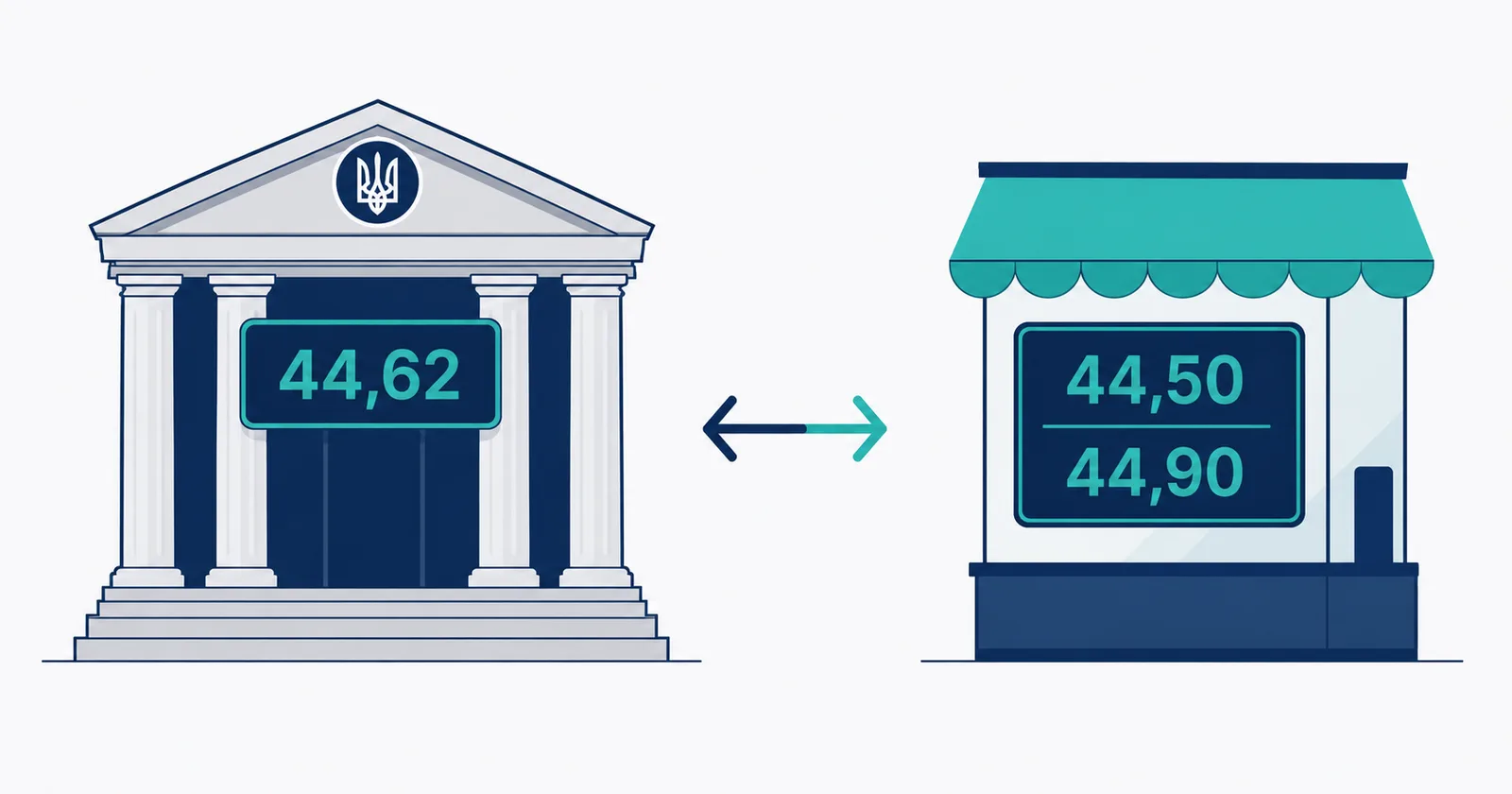
The NBU exchange rate and the exchange rate differ because they are two different markets: the official exchange rate is the average price of the cashless dollar in large transactions between banks, and the exchanger sells cash to a specific person and includes expenses, risk and profit in its price. Therefore, the cash dollar is almost always 20-60 kopecks more expensive than the official rate, and this is not a fraud, but normal market mechanics. We analyze where each rate comes from, what the spread is, and how to pay less for the currency.
Where does the official rate of the NBU come from?
Since October 2023, the regime of managed flexibility has been in effect in Ukraine: the exchange rate is not fixed, but is formed by the market under the supervision of the regulator. Every day, banks trade currency with each other on the interbank market, the NBU calculates the official exchange rate based on these transactions and publishes it — this is the figure you see on the NBU exchange rate page. That is, the official exchange rate is the actual average price of large non-cash transactions, not the National Bank's "desire". The NBU's role is to smooth out jumps: when demand for currency exceeds supply, it sells currency from reserves, keeping the market from sharp movements.
Why exchange rates and banks are different
The cash market lives by its economy. The money changer or the bank's cashier sets the exchange rate for three things. The first is expenses: rental of points, collection, security, salaries, purchase of the cash currency itself, which still needs to be physically delivered. The second is risk: the point assumes exchange rate fluctuations between the purchase and sale of the currency and the risk of being left with the "wrong" currency in the event of a sharp market movement. The third is profit, which forms the difference between the buying and selling rate. This difference is called the spread: for example, "buy 44.50 / sell 44.90" means a spread of 40 cents. In calm periods, the spread narrows to 10–20 kopecks, in moments of panic or uncertainty, it widens to hryvnia and more — this is how the market insures itself against sudden movements.
How many courses are there?
None of them are more "real" than the others - they serve different operations. For a person with cash, the real exchange rate is the exchange rate in his city; the official rate of the National Bank of Ukraine is a reference point from which it is convenient to calculate how profitable the offer in front of you is.
Why rates differ even between neighboring exchangers
Each point balances its own currency reserves. An exchanger that urgently needs dollars puts a higher buying rate; the one with too many dollars is a more attractive selling rate. Local factors are added: competition on a specific street, turnover volumes, the owner's appetite for risk. Therefore, within the limits of one city, the difference on the dollar easily reaches 20–30 kopecks — on the exchange of 1,000 dollars, this is 200–300 hryvnias, which can be saved by simply comparing the exchange rates in advance by comparing the exchange rates of banks and exchangers, and not bypassing points with your feet.
How to pay less for currency: short rules
Compare rates online before exchanging - the spread between points in your city is almost always bigger than it seems. Avoid exchanges in "tourist" places (stations, airports) - there is traditionally the widest spread. It is more profitable to exchange large amounts in a bank or a large exchanger with the possibility of reserving the exchange rate. Watch the moment: on days of panic news, spreads widen, and if the exchange is not urgent, it is better to wait a few days. And the last piece of advice: a course that is significantly better than the market is a reason not to rejoice, but to be wary, especially in online ads.
Frequently asked questions
Which exchange rate is "real" - the NBU or the exchange rate?
Both are real, but for different operations: the NBU exchange rate is the average price of large non-cash transactions between banks, the exchanger exchange rate is the price of cash for individuals, taking into account the costs and risk of the point.
Why is the cash dollar more expensive than the official rate?
Because the cash exchange rate includes costs for the delivery and storage of cash, collection, rent and the risk of fluctuations. In normal periods, the difference is 20–60 kopecks.
What is a spread?
The difference between the buying and selling rate at one point. The narrower the spread, the fairer the price for the client. In a calm market, the spread on the dollar is 10–30 kopecks, on turbulent days it is up to the hryvnia and more.
Can the exchanger set any rate?
Yes, each point determines the cash rate independently — the regulator does not fix it. The rate is limited only by competition and the willingness of customers to look for better offers.
Where to see the most profitable rate in your city?
In online aggregators that collect rates of banks and exchangers in real time, it is faster and more accurate than calling the points. On the exchange of 1,000 dollars, the comparison saves 200–300 UAH.
The material is informative.

 EN
EN